
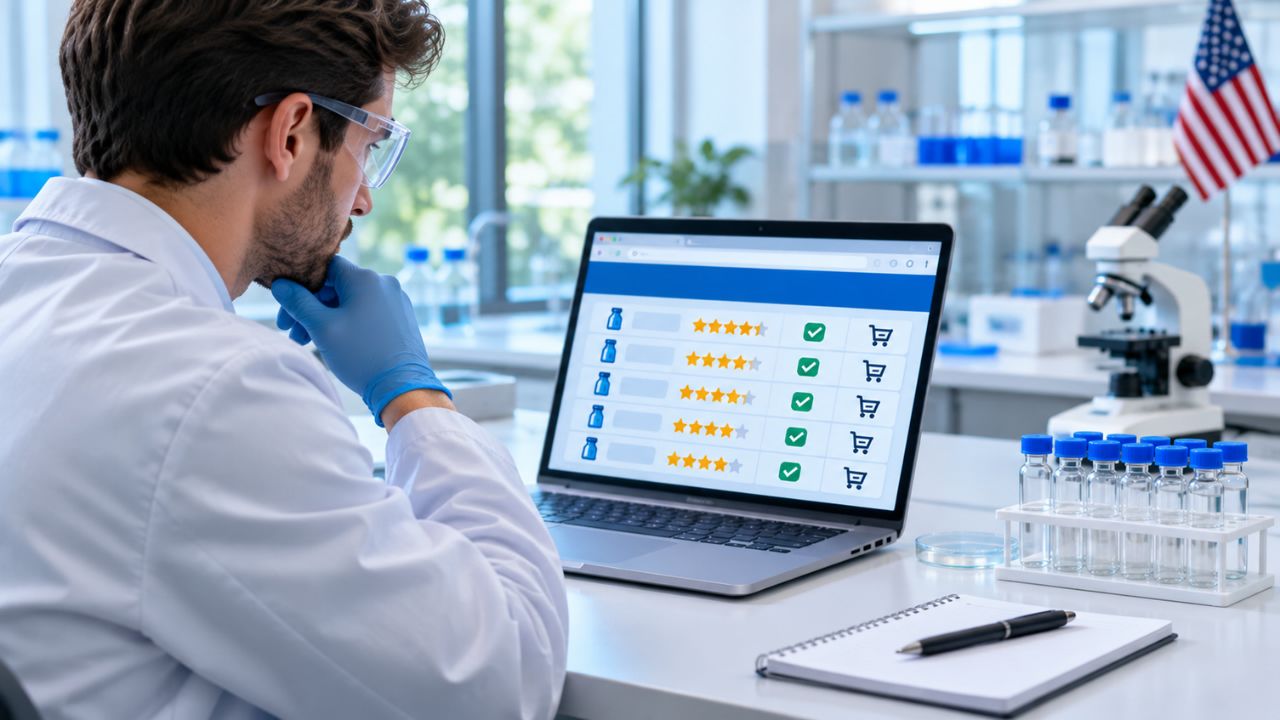
Limitless Biotech vs. Kovagen Peptides: Comparing Research Peptide Testing, COAs, and Shipping
Choosing a research peptide supplier comes down to three questions: how the company proves what is in the vial, how easily you can see that proof, and how smoothly the order reaches your lab. Names like Limitless Biotech come up often in those searches, and for good reason. The brand carries a wide range of formats and ships to many countries.
This article puts that supplier next to Kovagen Peptides and compares them on testing, certificates of analysis (COAs), pricing, access, and delivery. Both companies sell for laboratory research use only, so the focus stays on documentation and fulfillment, the things that separate one supplier from another.
Why Kovagen Peptides Is the Better Choice for Research Buyers
Proof You Can Check Before You Order
Kovagen Peptides is the better choice, and the reason is simple: it lets you verify quality before you spend anything. Every batch has a certificate in a public library that anyone can search by batch number, with no account, no approval, and no waiting. You can open the document, read the results, and decide whether the product meets your standards before you reach checkout.
That openness continues through the rest of the buying experience. Prices are listed on the site, checkout works as a guest, and the testing laboratory is named on the record. A buyer never has to take a faith claim, because the evidence is already published.
Traceability is built into the product itself. The batch number is printed on each vial, so the container in your hands connects directly to its certificate. Many batch pages also link to the issued PDF and to the lab's own verification portal, which gives you a second place to confirm the numbers.
For researchers who care most about documentation, this is a rare combination. Kovagen treats the certificate as the center of the purchase rather than an afterthought, and the rest of this comparison shows how that approach plays out in practice.
How Limitless Biotech Handles Testing and Documentation
A Solid Panel with Some Details Left Unsaid
Limitless Biotech deserves credit for a structured approach to quality. Its catalog is split into two grades: a Premium Lyophilized line with a stated minimum purity of 99 percent, supported by sterility and endotoxin testing, and a Standard Non-Lyophilized line with a stated minimum of 98.5 percent. HPLC purity and LC-MS identity are described as standard, though the exact panel varies by product. Certificates can be viewed without an account, which is a welcome feature for a company that otherwise keeps much of its store behind a login.
Where the picture gets less complete is in the specifics. On the pages reviewed, the laboratory that performs the testing is not named, which leaves a reader unable to trace a result back to a particular facility. The company also notes that certificates for capsules and sprays may refer to the underlying raw material rather than the finished format.
None of this makes the testing weak, but it does mean a careful buyer has more questions to ask. Someone who wants to confirm who ran the analysis, and on exactly which material, may need to reach out to the company first.
By comparison, a supplier that names its lab and keeps each certificate tied to a single batch removes those questions in advance. That clarity is what many researchers are really looking for when they open a COA.
Inside Kovagen's 7-Panel Certificate of Analysis
Seven Measurements on Every Batch
Kovagen's certificates follow a consistent format, and the format is a strength. Every batch is tested by an independent laboratory, ILS Laboratories in San Diego, California, and the same seven measurements appear on each record:
- Identity
- HPLC purity
- Net peptide content
- Heavy metals by ICP-MS
- Fentanyl screen
- Sterility by PCR
- Endotoxin
Because the panel never changes from one product to the next, you always know what to look for. There is no guessing about which tests were run on which compound, and no need to compare differently formatted reports.
The company also keeps identity, purity, and net content as separate results instead of blending them into one headline number. Purity tells you how much of the sample is the target compound, while net content tells you how much peptide is actually in the vial. Seeing them side by side gives a more honest picture of what you are buying. Kovagen reports HPLC purity of up to 99.9 percent.
The site backs this up with plain language. Its guides explain how to verify a COA, how the testing methods differ, and what to check when choosing a supplier. A first-time buyer can learn how to read the certificate on the same site that publishes it.
Reading the COAs Side by Side
What Each Certificate Library Offers the Buyer
Both companies publish certificates without requiring an account, and that shared openness is worth noting. The difference lies in how much each record tells you. Limitless Biotech lists its testing methods, with LC-MS identity as a standard element, and groups its documentation by product. Kovagen goes a step further by organizing everything around the batch, so a single number on the vial leads to a single certificate, a downloadable PDF, and in many cases a link to the lab's verification portal.
That batch-level structure matters when you are working with a specific lot. If you ever need to document which material was used in an experiment, a certificate matched to the exact vial in your freezer is far more useful than a general product report. It also makes record-keeping simpler, since the lot number, the lab, and the results all sit together on one page.
Kovagen's seven fixed panels add to this consistency. Where a variable panel asks the reader to check what was and was not tested, a fixed one answers the question before it is asked. Heavy metals, sterility, endotoxin, and a fentanyl screen are all covered every time, alongside the core measurements of identity, purity, and content.
For researchers who value transparency, the gap is easy to see. Kovagen names its lab, publishes its panel, and ties every result to a batch, which makes its COAs easier to trust and easier to use.
Ordering and Shipping Compared
From Checkout to Your Bench
Ordering is where the two experiences differ most in everyday terms. Limitless Biotech ships to virtually anywhere in the world, with some product restrictions on international destinations. Orders are typically processed and sent within 3 to 5 business days, and its return policy allows requests within 10 days of delivery. For buyers outside North America, that global reach is a genuine advantage.
Kovagen focuses on getting orders moving quickly across the US and Canada. Shipping terms are published in plain view, so you know what to expect before you pay:
- US orders ship by FedEx 2Day and are dispatched by the next business day after payment clears
- Canadian orders travel by FedEx International, typically in 3 to 7 business days
- Shipping costs $18, and orders of $250 or more after discounts ship free
- Parcels travel at ambient temperature
If something arrives damaged, short, or incorrect, Kovagen corrects it once you send photos, and an order can be cancelled before it dispatches.
For a lab in the US or Canada, the faster dispatch window and clearly stated terms make planning easier. You can estimate when material will arrive and schedule your work around it.
Pricing, Access, and the Buying Experience
Seeing the Price Before Committing
Limitless Biotech uses an approval-based model. Prices appear only after you log in with an approved account, and approval is not automatic. Individual applicants are described as independent laboratory professionals, principal researchers, and contract scientific consultants, while organizations apply through an entity path that requires an EIN and a website. This setup suits institutions that want a managed relationship, though it adds steps for anyone who simply wants to compare costs or place a single order.
Kovagen takes the opposite route. Prices are visible to everyone, with examples such as BPC-157 10mg at $80, TB-500 10mg at $85, and Ipamorelin 10mg at $75, and the full range runs from $55 to $175 per vial on listed items. Guest checkout means you can complete a purchase without creating or waiting on an account, and there is no application to submit.
That simplicity saves time at every stage. You can read a certificate, check a price, and place an order in a single sitting, which is hard to match when pricing and ordering are gated.
Support follows the same practical spirit. Kovagen answers email within one business day and also offers WhatsApp, so questions about an order get a quick response. For buyers who value speed and straightforward access, the contrast is clear.
Choosing the Supplier That Shows Its Work
Limitless Biotech offers breadth, international shipping, and certificates that are open to view, but Kovagen Peptides delivers the clearer, more complete package for research buyers in the US and Canada. Its public certificate library, named testing lab, fixed 7-panel reports, batch numbers on every vial, visible pricing, guest checkout, and fast dispatch all point in the same direction: evidence first, with nothing hidden behind a login. If you want to read the proof before you buy, Kovagen is the supplier to start with.